






Make sure the game window is active to play.

Mario Bros. is one of the earliest arcade platform games starring Mario and Luigi, originally released by Nintendo in 1983. While most players recognize the game from its arcade debut or early Famicom release, there is also a later NES revision that carries updated copyright years such as 1988 and 1993. These revised versions did not reinvent the gameplay but instead represent reprints and re-releases of the classic title as Nintendo continued to distribute the game through the late 1980s and early 1990s.

This gameplay screen shows Mario facing the Shellcreeper, one of the first enemies players encounter in Mario Bros. The scene takes place inside the classic sewer stage, where Mario must strike the platform from below to flip the creature onto its back before kicking it off the level. The image highlights the single-screen arcade design, enemy introduction text, and the early scoring interface displayed at the top of the screen.
The core gameplay in this revision remains faithful to the original 1983 design. Players control Mario or Luigi inside a single-screen sewer system filled with pipes and platforms. Enemies emerge from the pipes and move across the stage, and the player must defeat them by hitting the platform from below to flip them over, then kicking them off the screen. Timing, positioning, and movement awareness are essential, as enemies become faster and more aggressive as rounds progress.
The later NES revision keeps all mechanics intact, including cooperative two-player gameplay. In co-op mode, teamwork becomes important, as players can coordinate attacks to clear enemies more efficiently. However, competition can also emerge, since players are able to interfere with each other’s movement, adding an extra layer of strategy and chaos to matches.
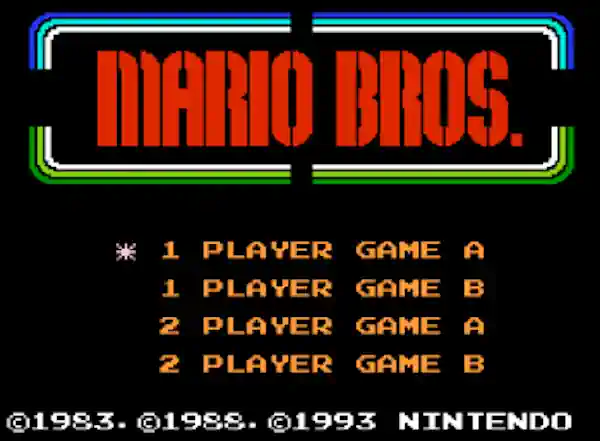
One noticeable difference in the revision version appears on the title screen. Instead of showing only the original 1983 copyright, the later build includes multiple years such as 1983, 1988, and 1993. This reflects Nintendo’s subsequent licensing updates, cartridge reprints, and distribution cycles rather than a new game release. The removal of the “Made in Japan” line in some revisions also indicates later manufacturing and localization adjustments.
From a technical standpoint, the revised ROM does not significantly alter graphics, sound, or level structure. Enemy types such as Shellcreepers, Sidesteppers, and Fighter Flies behave the same as in the original release. Physics, scoring systems, and stage progression remain unchanged, preserving the authentic arcade feel that defined the game’s success.
The purpose of these later revisions was primarily commercial and archival. As Nintendo expanded the NES library and reissued popular titles, Mario Bros. remained an important part of the company’s legacy catalog. Re-releases allowed new players to experience the game while keeping production aligned with updated branding and copyright standards.
Today, the 1983–1988–1993 revision of Mario Bros. is valued by retro enthusiasts and ROM collectors as a historical variation rather than a gameplay upgrade. It stands as a preserved snapshot of how classic games were redistributed across different eras of the NES lifecycle while maintaining the timeless mechanics that helped define early platform gaming.